


In late December 2009, Washington Wizards star Gilbert Arenas dropped two high caliber hand guns on a chair in the Verizon Center locker room. Across from him, his younger teammate Javaris Crittenton reached for his own chrome 9mm. The confrontation, sparked by a gambling dispute on the team’s charter flight, would become one of the most surreal chapters in NBA history. Most were concerned with the actions of the two players, but the larger question was how the NBA itself enabled the transport of those firearms. The answer reveals a web of relaxed security and ignored policies that left the league vulnerable to both scandal and liability.
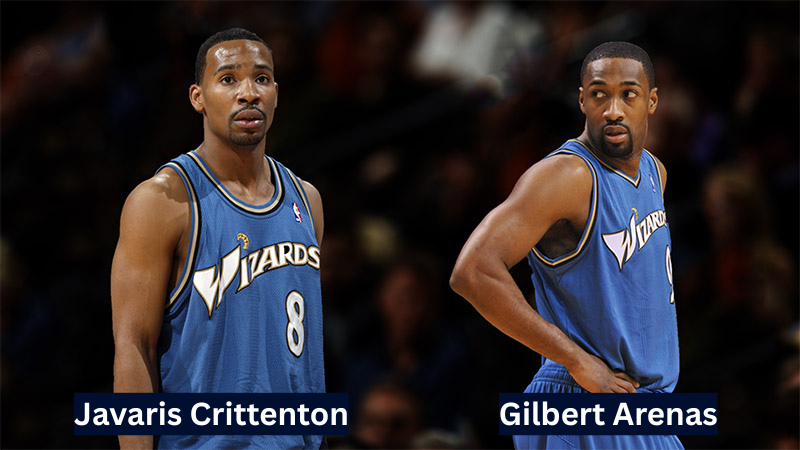
The immediate spark was small: a $200 gambling debt during a team flight. Trash talk between players Crittenton and Arena’s escalated into threats, Arenas threatened to light Crittenton’s car on fire, Crittenton replied he’d shoot Arenas in the knees [1]. Arenas called his bluff and dared him to do it, even promising to supply the guns.
That promise wasn’t bluff though. By his own admission, Arenas owned over 460 firearms from Desert Eagles to AK-47s. a collection he’d started after buying a college girlfriend’s father’s stash [2]. And, crucially, many of those weapons were transported across state lines using the Wizards’ charter flights.
The player’s personal feud actually highlighted some egregious policy failure: the league’s private planes had become a tool for gun trafficking.
The NBA wasn’t blind to firearms risks. In 2005, following several high-profile gun incidents, the league negotiated a collective bargaining clause banning firearms on team property, planes, and at league events[3]. Yet enforcement was uneven. In 2006, Sebastian Telfair of the Portland Trail Blazers was fined after a loaded pistol was found wrapped in a pillowcase aboard the team plane [4]. The league punished him lightly, treating it as a one-off embarrassment rather than a systemic breach. That precedent mattered. If guns could slip onto planes in 2006 with little consequence, why would Arenas think twice in 2009 when he trafficked guns?
The core vulnerability lay not in the locker room but at 35,000 feet in the NBA’s private jet
Unlike commercial passengers, NBA teams travel on private charters exempt from routine TSA screening. For years, athletes had what one security analyst called a “free pass” through airports [5]. After 9/11, lawmakers debated closing the loophole, but leagues like the NBA lobbied against stricter rules.
Technically, the Twelve Five Standard Security Program (TFSSP) required additional security measures for charters over 12,500 pounds or 61 seats [6], the size of NBA team jets. But enforcement was inconsistent, and inspections rare. A 2023 European audit described the lack of private jet checks as “scandalous” [7].
That gap allowed Arenas to shuttle weapons between states with little chance of discovery. The NBA’s own travel arrangements became his smuggling network.
Journalist Peter Vecsey, who broke the locker-room gun story, later mused about the bigger question: how did Arenas’ guns get there in the first place? He pointed to the failure of both team security and league oversight [8].
Within the Wizards’ front office, executives weren’t clueless. Team president Ernie Grunfeld confirmed key details of the standoff to reporters [9]. And according to Arenas, rumors about his gun stash in the locker room had circulated even before the standoff [1].
Knowledge without enforcement amounts to negligence, a dangerous place for any employer to be.

Legally, employers face liability when unsafe conditions at work harm others. Many states allow companies to ban firearms on their property and hold them accountable for failing to enforce those bans [10].
Applied here, the Wizards provided the physical space (locker room) and the transport (team plane) that enabled Arenas’ misconduct. At minimum, the NBA had a duty to enforce its own policies. By failing to secure planes or monitor compliance, the league arguably created the conditions for violation.
Yet no lawsuit ever targeted the NBA. Discipline stayed internal: Commissioner David Stern suspended Arenas for 50 games, Crittenton for 38 [11]. Liability was treated as a reputational crisis, not a legal one.
The Arenas episode wasn’t unique, there are other cases and even a pattern. In 2006, Telfair smuggled a pistol onto a team plane [11]. In 2011, former player Darius Miles was arrested with a loaded gun in his carry-on at an airport [11]. In 2023, Ja Morant’s livestreamed gun flashes reignited debate about culture and oversight [1].
In each case, the NBA had unequal discipline. The league toted its zero tolerance policy on paper, but its enforcement of that policy told another story.
So why wasn’t the NBA sued or held criminally liable for Arenas’ alleged gun trafficking?
- Private charter opacity: With no TSA lines or public witnesses, the incidents stayed internal until leaks hit reporters.
- Discipline as damage control: Stern’s historic suspension insulated the league from charges of inaction. The bigger the headline = harsher punishment.
- No direct victim inside the NBA: luckily, in the Arena’s/Crittenton situation, there was no actual victim. The tragedy came later, when Crittenton, years out of the league, killed a bystander in Atlanta. But if there was a victim while Crittenton was actively in the NBA, then it would most likely lead to punishments or discipline for the NBA
In short, the NBA avoided court not because it wasn’t exposed, but because no plaintiff with standing ever pressed the issue.
The Arenas/Crittenton scandal is often remembered as a bizarre footnote in NBA history, when talking shit goes too far, a career-ending embarrassment. But it should be remembered as something more: a warning about negligence.
The league had a policy against guns on planes and their personal property [3]. It had precedents like Telfair showing that violations were possible without real discipline [3]. It had executives aware of Arenas’ collection and transportation [3]. And yet, its relaxed enforcement and reliance on private charter loopholes allowed smuggling to continue unchecked.
Fifteen years later, as new controversies surface, the NBA’s refusal to confront its blind spots raises the same question: how much liability can a league ignore before things go too far?
References:
- Yahoo Sports (Untold: Shooting Guards)sports.yahoo.com
- SB Nation / Esquire interviewsbnation.com
- ESPN, NBA weighs suspension for Arenasespn.com
- ESPN, Trail Blazers guard fined after gun found on planeespn.com
- Tampa Bay Times, Athletes may lose free passtampabay.com
- NBAA, Private Charter Security Programnbaa.org
- Yahoo UK, Lack of private jet securityuk.news.yahoo.com
- Reason Magazinereason.com
- ESPN (Caron Butler/Grunfeld recollections)espn.com
- Texas Workforce Commission, Weapons at Workefte.twc.texas.gov
ESPN, Darius Miles caseespn.com






Honestly, this site is so easy to navigate. I had a smooth experience logging in and the games load super fast. Definitely my go-to now! jili31login
Your point of view caught my eye and was very interesting. Thanks. I have a question for you.
The variety of games here is insane. I love how easy it is to navigate through the lobby. I’m spending most of my free time on idsgo777 these days.
I was skeptical at first but this place is legit. Smooth transactions and a great variety of options to choose from. pk1777xs
Joining hz88wvip gave me exactly what I was looking for in a premium gaming site. The VIP ladder is fair and each tier unlocks real benefits that improve my overall experience. I tested the table games and noticed the dealers are professional and the streaming quality is top notch. Withdrawals hit my e wallet within two business days and the platform never goes down during major tournaments. Quality over everything here. hz88wvip
Finally found a place where downloads actually work without any hassle. Super easy to navigate and very efficient. Cheers! j555gamedownload
Honestly, the registration process was a breeze. I started playing within minutes and the graphics are top notch. Highly recommend it to anyone looking for a reliable platform. vnyly88
This place feels premium. The graphics are sharp and the gameplay is seamless. If you want a quality gaming session go for jiliglorycasino.